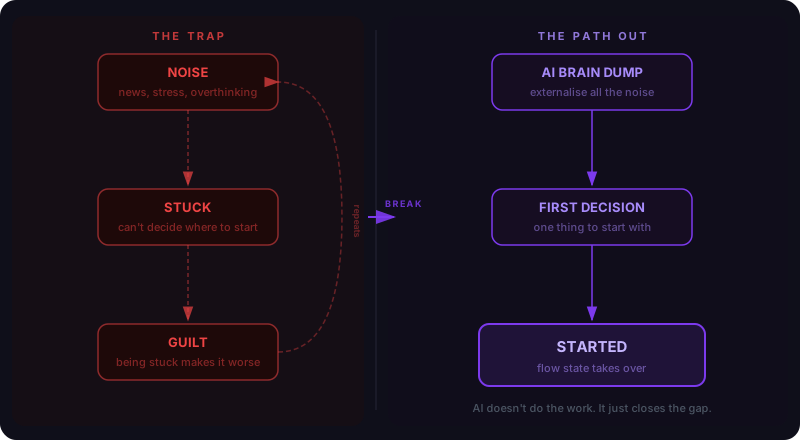
- ADHD isn't a laziness problem or a focus problem. It's a start problem. The noise in your head fills the mental space you need to decide what to do first.
- A brain dump prompt gives AI everything cluttering your head and asks it to sort the mess. You're not asking AI to solve your problems. You're asking it to hold the weight for a minute so you can breathe.
- Don't ask AI for a schedule or a plan. Ask for one thing to start with. One decision is all it takes to break the stuck loop.
- The same logic applies mid-task and at the finish line: ask for the smallest possible next action, not a plan.
- Once you're in flow, you won't need any of this. These prompts are only for the gap.
By 9am, I had twelve open tabs. A news article I couldn't stop reading about something I had no control over. A work message that landed wrong and that I'd been mentally rewriting for forty minutes. A conversation I kept replaying from two days ago. Three tasks I needed to start, none of which I'd touched. And a growing awareness that I was wasting the morning, which made it worse.
I have ADHD. Not the bounce-off-walls kind. The kind where I can sit completely still for three hours and get nothing done, then spend the next six locked in a flow state that won't break for anything. The gap between those two states is what this is about.
Once I'm in flow, nothing stops me. The problem is getting there. And on mornings when the noise is loud, the gap between stuck and started can eat half a day.
I've started using AI to close that gap. Not because it's a magic fix, and not because I always do it intentionally. Sometimes I just open a chat window and start dumping thoughts, and twenty minutes later I'm working. These are the prompts that made that repeatable.
ADHD isn't a focus problem. It's a start problem.
People picture ADHD as an inability to concentrate. That's not how it works for me, and it's probably not how it works for you either. I can hyperfocus for six hours on something genuinely interesting. Focus isn't the issue.
The issue is the mental space required to make the first decision. Choosing what to do next sounds trivial. It's not. It requires a mind that's reasonably clear, reasonably calm, and not drowning in competing inputs. On a good morning, that's easy. On a bad one, the decision itself becomes the obstacle.
Here's the loop: something external creates noise. News, a tense message, a worry you can't resolve. That noise fills the space you need to decide. You can't decide, so you don't start. You don't start, so the guilt of not starting piles on top of the noise. Now you have even less mental space. You scroll. You read more news. You rewrite the message in your head again. An hour is gone.
The exit isn't willpower. It's externalising the noise. Getting it out of your head and into something you can look at. That's always been true. AI just makes it faster and easier to do.
ChatGPT Prompts for ADHD: The Brain Dump
When the noise is too loud to think through, the first move is to dump it somewhere. Not organise it. Not solve it. Just get it out.
This is the prompt I use more than any other:
Prompt: Brain Dump
I'm struggling to focus this morning. Here's everything on my mind right now: [dump everything — work tasks, personal worries, things you can't control, half-thoughts, random anxieties]. Sort this into three buckets: things I can action today, things I need to let go of for now, and things that are just noise. Then tell me one thing to start with.
Fill in the brackets honestly. Don't filter. The whole point is to get the unfiltered mess out of your head, not to present a tidy version of it.
What comes back is something your brain couldn't produce on its own in that state: a sorted, calm view of what's actually in front of you. You're not asking AI to solve your problems. You're asking it to hold the weight for a minute so your brain can breathe.
The sorting matters less than the act of externalising. Just putting it somewhere outside your head creates a small but real shift. The follow-up, the "one thing to start with," gives you somewhere to direct that shift.
What Do You Do When You Can't Figure Out What to Start?
For ADHD, choosing is as hard as doing. Task initiation difficulty is one of the core executive function challenges that comes with the condition, as ADDitude covers extensively. Too many options and the brain freezes. A full task list isn't helpful in the stuck state. It's overwhelming. You need someone to narrow it down to one.
This prompt does exactly that:
Prompt: First Task
Here are all my tasks for today: [list]. I have roughly [X] hours. Don't give me a schedule. Just tell me the one thing to start with right now, and why.
The "don't give me a schedule" instruction is important. A schedule is more decisions. You don't need that. You need one decision. The first keystroke. Everything after that is easier.
What Should You Do When You're Stuck Mid-Task?
You started. That's real progress. But now you've hit a wall mid-way through and you're in a worse place than before you started. You haven't finished, but you can't continue. You can't start something new because this thing is still open. You're in no-man's-land.
Task-switching is the second ADHD killer. The incomplete thing sits there like a weight, but engaging with it feels impossible.
Prompt: Mid-Task Wall
I'm working on [task] and I've hit a wall. Here's where I am: [describe what you've done and where you stopped]. What's the smallest possible next action that would move this forward? Not a plan. One action.
The key phrase is "not a plan." A plan requires you to think ahead. One action just requires you to move. Put the next word down. Open the next tab. Write the rough version. Any small forward motion breaks the paralysis.
The finish problem
Starting is hard. Finishing is harder. There's a specific ADHD pattern where 80% done is somehow as stuck as 0%. The task has lost its novelty. The end isn't exciting enough to pull you forward. It just sits there, incomplete, adding weight to every morning.
Most people with ADHD have a collection of these. Documents that need one more pass. Emails that need a final reply. Projects that are basically done but somehow never closed.
Prompt: Close the Loop
I have these half-finished things: [list]. Which one is closest to done and what's the actual final step to close it?
The question "which one is closest to done" does something specific. It reframes the problem from "I have a pile of unfinished things" to "one of these is nearly there." That one is worth picking first. Closing something, even a small thing, changes the mental state more than starting something new.
The goal isn't to work more
None of these prompts are about productivity optimisation. They're not about doing more or being more efficient. They're about not losing the morning. About closing the gap between where you wake up and where you can actually function.
Once you're working, you won't need any of this. The prompts are just for the gap. Use them when the noise is loud, put them down when it isn't.
I've been writing this article for a few hours now. That's the lock-in state. Getting here took one brain dump prompt and about fifteen minutes.
Frequently asked questions
It's not therapy and it won't replace what works for you medically. But for the specific problem of getting unstuck, it helps in a real way. ADHD brains often need to externalise thoughts before they can act on them. Talking to a person works. Writing in a journal works. AI works for the same reason: it gets the noise out of your head and into a format you can respond to. These prompts are for the gap between stuck and started, not a substitute for anything else.
That's fine. Start with that. Type exactly that: "I can't even describe what's in my head right now. I just feel stuck and overwhelmed." Then keep going with whatever fragments you have. AI is good at working with half-formed thoughts. You don't need to be articulate. You just need to start typing.
A to-do list requires you to already know what to do and be in a state where you can make decisions. The problem with ADHD on a bad morning is that you're not in that state. The brain dump prompt works before the to-do list: it gets you out of overwhelm first, then gives you one decision to make. The to-do list is for when you're already functioning. This is for when you're not.
It doesn't work every time. Sometimes the problem is deeper than a brain dump can fix. If that's where you are, lower the bar further: don't ask "what should I start?" Ask AI for the smallest possible action that isn't even work yet. Open the document. Reply to one email. Move your body for five minutes. Starting something, anything, changes your brain state faster than thinking about starting.
No. The stuck loop described here, noise filling the mental space you need to decide and start, happens to a lot of people who have never been diagnosed. If this description sounds familiar, the prompts will still work. A diagnosis isn't a requirement for using a tool.