- Most resumes fail because they focus on responsibilities, not results. Numbers are proof, everything else is just words.
- AI can rewrite your resume in minutes, but only if you give it a structured prompt. "Rewrite my resume" gives you garbage.
- Use the STAR method (Situation, Task, Action, Result) to turn vague bullets into specific, measurable achievements.
- Tailor your resume for every job posting. This takes 10 minutes with AI and triples your callback rate.
- AI gives you 80%. Your personal touch, your voice, your real numbers give the final 20% that makes it yours.
- Keep your resume to one page. If you can't explain your value concisely, that's a red flag to hiring managers.
I've spent over 10 years on both sides of the hiring table. I've applied for jobs with zero experience and somehow gotten hired. I've also spent a full year trying to fill a single Senior Paid Media position and ended up hiring someone I already knew, because every resume I received was, honestly, catastrophic.
I'm going to tell you exactly what goes wrong with most resumes, what actually makes a hiring manager pick up the phone, and how AI can fix your resume in minutes. If you know how to use it right.
This isn't another generic "10 resume tips" article. This is what I've learned from reviewing hundreds of applications, hiring (and getting burned), and eventually figuring out what separates the people who get callbacks from the people who hear nothing. If you're job hunting in 2026, AI is the single biggest advantage you can give yourself. But only if you use it correctly.
What Actually Makes Me Want to Call Someone
Results with numbers · Personality · One page
Why Do Most People Fail at Using AI for Their Resume?
The Difference a Good Prompt Makes
How to Use AI for Your Resume
Step 1 · Step 2 · Step 3 · Step 4 · Step 5
Which AI Should You Use?
The 80% Rule
What I'd Do If I Were Job Hunting Today
FAQ
I Spent a Year Reviewing Resumes. Here's What I Saw.
When I was hiring for a Senior Paid Media role to handle clients in the Gulf markets, I expected to find strong candidates quickly. Instead, I spent an entire year reviewing applications. Hundreds of resumes. Want to know what most of them looked like?
The same. They all looked the same.
Not similar. The same. Like everyone attended the same "How to Write a Resume" workshop in 2014 and never updated their approach. Here's what kept showing up:
- "Results-driven professional". I saw this phrase so many times I started using it as a drinking game. Nobody who writes "results-driven" has ever shown me an actual result.
- "Expert" with 1 year of experience. In what world does 12 months make you an expert? This tells me you don't understand the field you're claiming to master.
- "Result-oriented team player with a passion for...". Stop. I already stopped reading.
- 3-4 page resumes for a mid-level position. I should understand who you are in under a minute. If your resume is 4 pages, you don't know what matters.
- That opening paragraph. "I am seeking a challenging position that will allow me to utilize my skills and grow professionally..." I know you want a job. That's why you applied. Tell me why I should care.
- Copy-paste job descriptions. I can tell when someone has just copied the responsibilities from their old job posting. If your bullet points sound like a job listing instead of an accomplishment, you've already lost me.
- Irrelevant skills sections. Listing Microsoft Word and "good communication skills" in 2026 is like listing "can use a telephone." It takes up space and tells me nothing useful.
During that year, I hired two people. Both quit within two weeks. Not because of the work. They just found better opportunities in that window. Back to square one.
I eventually hired someone I already knew personally. Minimal experience, but I trusted them. You know what that tells you? The resume process is broken. And the people who know how to fix theirs have a massive advantage.
The whole experience changed how I think about resumes. Most people treat them like a formality, a checkbox to fill out before hitting "Apply." But for the person on the other side of the table, your resume is the only thing standing between you and a phone call. It's doing the talking for you before you ever get to say a word.
What Actually Makes Me Want to Call Someone
Here's what most career advice won't tell you: I'm not just looking at your skills. I can teach skills. What I can't teach is how someone thinks, communicates, and shows up.
When I review a resume, I'm looking for three things:
1. Show me what you actually did, with numbers
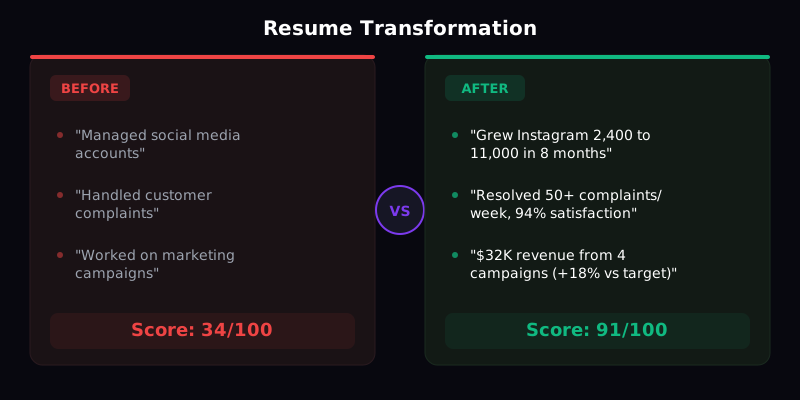
Don't tell me you "managed social media accounts." Tell me you grew Instagram from 2,400 to 11,000 followers in 8 months. Don't say you "handled advertising campaigns." Tell me you managed $50K/month in ad spend and hit a 4.2x ROAS.
Numbers are proof. Everything else is just words.
This is the single biggest difference between a resume that gets a callback and one that gets ignored. When I see numbers, I see someone who actually tracked their work and cared about outcomes. When I see vague descriptions like "improved performance," I assume you either didn't measure anything or the numbers weren't impressive enough to mention.
Even rough estimates work. "Increased email open rates by approximately 35%" is infinitely better than "responsible for email marketing campaigns." Give me something concrete to hold onto.
2. Show me your personality
This is the one nobody talks about. I want to know who you are beyond the job description. When I got my first job in digital marketing, over 10 years ago, I applied for an SEO position. I knew absolutely nothing about SEO. Zero.
But the interviewer liked me. Not my skills (I had none), not my resume (it was thin). Me. My personality, my energy, my honesty about what I didn't know. They offered me a Paid Media intern position instead, and we actually laughed about the fact that I had no idea what I was doing.
That's what I mean. Your resume should give me a sense of who you are. A one-page document that's all corporate buzzwords tells me nothing about the human I'd be sitting next to for 8 hours a day.
How do you show personality on a resume? It's subtle. Use your natural voice instead of corporate speak. If you built something you're proud of, let that come through. If you took on a challenge that scared you, mention it. You're not writing a legal document. You're introducing yourself to someone who's trying to decide if they want to work with you.
3. Keep it to one page
I should understand who you are, what you've done, and why you're relevant. In one page. If you can't communicate your value concisely, that's a red flag. It tells me you don't know what's important.
One page. Strong bullets. Real numbers. Done.
I know this advice is controversial. People with 15+ years of experience will say, "But I can't fit everything on one page!" That's the point. You shouldn't fit everything. You should fit the things that matter for this specific role. If your resume is four pages, you haven't made choices about what's important. And making choices about what matters is literally what I'm hiring you to do.
Why Do Most People Fail at Using AI for Their Resume?
Here's the problem. Everyone has access to ChatGPT now. So people type "rewrite my resume" and paste whatever comes out. The result?
"Managed social media accounts and created content for various platforms to increase engagement and brand awareness across multiple channels."
That's what AI gives you with a lazy prompt. It's technically correct and completely useless. A hiring manager reads that and thinks: "So... what did you actually do?"
The issue isn't AI. The issue is what you tell it to do. A vague prompt gets a vague result. A specific, structured prompt gets something you can actually use.
Think about it this way. If you walked up to a professional resume writer and said, "Make my resume better," they'd ask you a dozen follow-up questions. What role are you applying for? What are your biggest accomplishments? What numbers can you share? What makes you different from other candidates?
AI needs the same context. The difference is that AI won't ask follow-up questions. It'll just take your vague input and give you vague output. So you have to do the work upfront. You have to give it the specifics, the framework, and the rules. That's what makes a prompt actually useful.
The people getting the best results from AI aren't smarter or more technical. They just give better instructions. And that's a skill anyone can learn in about 10 minutes.
The Difference a Good Prompt Makes
When you give AI the right instructions - a specific framework like STAR, rules about action verbs, and a requirement to include real metrics - the output is dramatically different from what a vague prompt produces.
Same person, same experience. Different prompt:
With a basic prompt:
"Managed social media accounts and created content for various platforms to increase engagement."
With a structured prompt:
"Grew Instagram following from 2,400 to 11,000 in 8 months by creating a weekly content calendar and A/B testing 3 post formats, resulting in a 340% increase in engagement rate."
Same person. Same experience. Completely different impression. The second one makes me want to call them. The first one goes in the pile.
Here's another example. Say you worked in customer service:
With a basic prompt:
"Responsible for customer service operations and handling client inquiries across multiple channels."
With a structured prompt:
"Resolved 200+ customer tickets weekly across email, chat, and phone, reducing average response time from 24 hours to under 4 hours while maintaining a 97% satisfaction score."
See the pattern? The first version describes a job. The second version describes a person who is clearly good at that job. That's what a structured prompt does. It forces AI to think in terms of actions, numbers, and results instead of generic descriptions.
How to Use AI for Your Resume (The Right Way)
Here's the approach that actually works. It's a five-step process, and none of the steps involve typing "rewrite my resume" into ChatGPT and hoping for the best - because that approach never produces anything worth sending to a real hiring manager.
Step 1: Don't ask AI to "write your resume"
That's too vague. Instead, ask it to rewrite specific bullet points using a specific framework (like STAR: Situation, Task, Action, Result). Give it one experience at a time. Feed it the raw material and let it shape each piece individually. You'll get dramatically better output than dumping your entire resume into a chat window.
Step 2: Give it the messy version first
Write what you actually did in plain language, like you're telling a friend. "I managed social media and grew followers" is fine as input. "I handled customer complaints and figured out a faster way to respond" is perfect. Don't worry about making it sound professional. That's AI's job. Your job is to give it the raw truth.
Step 3: Include rules in your prompt
This is where most people drop the ball. Tell AI: use strong action verbs, include specific numbers, keep each bullet to 1-2 lines, avoid buzzwords like "results-driven" or "team player." Without rules, AI defaults to corporate garbage. With rules, it produces tight, specific, impressive bullet points. Think of rules as guardrails. The more specific your guardrails, the better the output stays on track.
Step 4: Tailor for every job
Don't send the same resume to 50 companies. Use AI to customize your bullets for each job posting. Paste in the job description and ask AI to highlight which of your experiences are most relevant and how to frame them for this specific role. This takes 10 minutes and triples your callback rate. According to LinkedIn's talent data, recruiters can tell when a resume was written specifically for their role, and it immediately moves you to the top of the pile.
Step 5: Run it through an ATS checker
Most companies use automated screening software called Applicant Tracking Systems. If your resume isn't optimized for ATS keywords, a human never sees it. AI can check this in seconds. Paste the job posting and your resume into AI, and ask it to identify missing keywords and suggest where to naturally include them. This is one of the highest-impact things you can do, and it takes less than a minute.
Which AI Should You Use?
Not all AI tools are created equal for resume work. Each has different strengths - some are better at generating structured bullet points, others at analyzing job descriptions and matching your experience to the right keywords. Here's how they compare:
| AI Tool | Best For | Version | Free? |
|---|---|---|---|
| ChatGPT | Structured content, ATS keywords | GPT-4o | Free tier available |
| Claude | Natural-sounding writing, cover letters | Sonnet 4.6 | Free tier available |
| Gemini | Research, company data | 3.1 Pro | Free tier available |
My recommendation? Start with whichever one you're most comfortable with. They all work well with a good prompt. If you're optimizing for ATS keywords, ChatGPT tends to be more systematic about matching job description language. If you want your cover letter or summary to sound natural and human, Claude is excellent at that. And if you want to research the company before tailoring your resume, Gemini can pull in useful context.
The prompts in our toolkit work with all three. You don't need to pick one and stick with it. Use them as different tools for different parts of the process.
The 80% Rule
AI gives you 80% of the way there. The last 20%, your personal touch, your voice, your judgment about what matters, that's what makes it yours. Don't submit AI output without reviewing it. Recruiters can spot lazy copy-paste.
But that 80% saves you hours. What used to take an afternoon now takes 15 minutes. And the quality is better than what most people produce on their own, because the AI forces structure that humans skip.
Here's what that last 20% looks like in practice. Read every bullet point out loud. Does it sound like something you'd actually say in an interview? If not, adjust the language. Check the numbers. AI sometimes invents metrics or exaggerates. Make sure everything is accurate. And add at least one detail that only you would know, something specific to your experience that makes the resume unmistakably yours.
The goal isn't to trick anyone. It's to present yourself clearly, concisely, and confidently. AI handles the structure and polish. You handle the truth and personality.
What I'd Do If I Were Job Hunting Today
Honestly? I'd use AI for everything. Not because I'm lazy. It's faster and better. Here's my exact process:
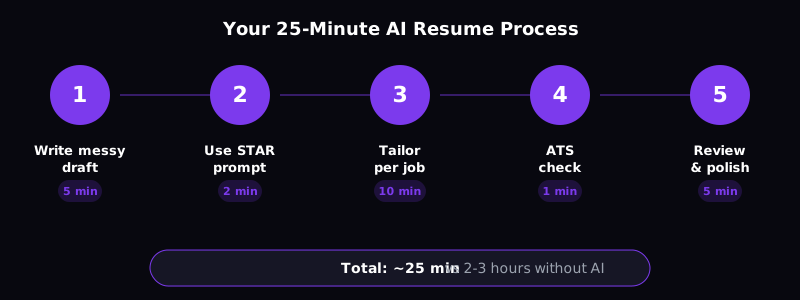
- Write my experience in plain language (5 minutes). Just dump everything I've done into a document. No formatting, no fancy words. Just the truth.
- Use a structured prompt to turn it into STAR-method bullets (2 minutes). Feed each experience into AI with specific rules about action verbs, numbers, and length.
- Tailor the resume for each specific job posting (10 minutes). Paste the job description, ask AI to prioritize and reframe my experience for this exact role.
- Run it through an ATS compatibility check (1 minute). Make sure the keywords match and the formatting won't break the system.
- Review, adjust, make it sound like me (5 minutes). Read it out loud, fix anything that sounds robotic, add personal details.
Total: about 25 minutes per application. Without AI, this takes 2-3 hours. And the result is better.
The people who figure this out first have an unfair advantage. Everyone else is still writing "results-driven professional" and wondering why nobody calls.
Frequently Asked Questions
Yes, and most people already do. 68% of job seekers use AI for resumes in 2026. The question isn't whether to use it, it's whether you're using it well. A bad AI resume is worse than no AI at all.
They can tell if you used it lazily. Generic output with buzzwords like "results-driven professional" is obvious. But a well-prompted, edited, personalized resume? No recruiter can tell, and frankly they don't care as long as it's accurate and well-written.
ChatGPT (free tier) for structured bullet points and ATS optimization. Claude (free tier) for cover letters and natural-sounding writing. Both work great with the right prompts.
Three things. First, use a specific prompt with rules (not just "rewrite my resume"). Second, add your own details and numbers. Third, read it out loud. If it sounds like something you'd never actually say, rewrite that part.
Yes, if you optimize for it. Use keywords from the job posting, avoid tables and columns, stick to standard headings (Experience, Education, Skills). AI can actually help with ATS optimization better than most humans can manually.
Want the exact prompts?
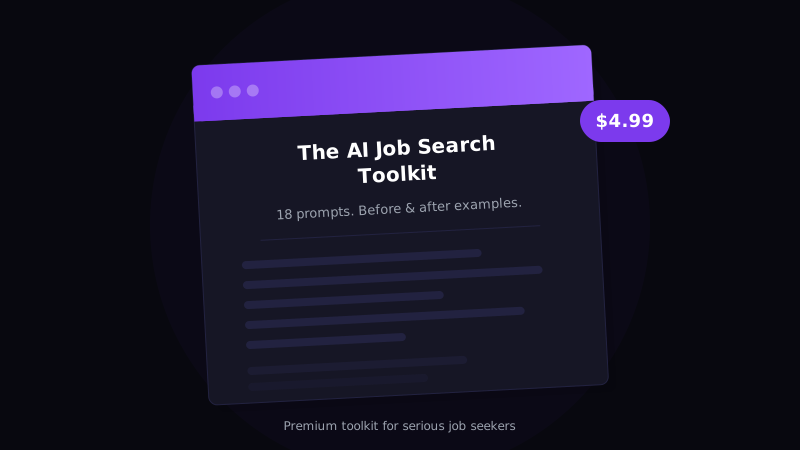
The AI Job Search System has 18 tested prompts for resumes, cover letters, LinkedIn, interviews, and salary negotiation. Each one comes with before & after examples.
See the System → $18.99