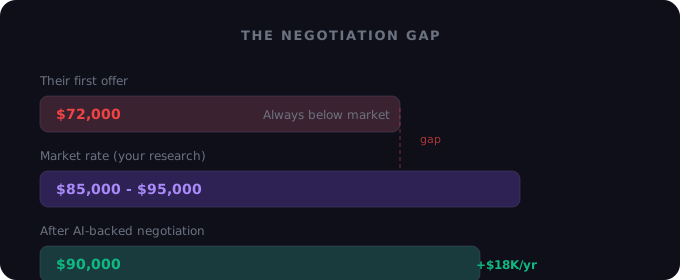
- 55% of people accept the first offer without negotiating. That's an average of $5K-$20K left on the table every single year.
- AI is best used before the conversation, not during it. Use it to research, script, and rehearse.
- Never give a number first. Use AI to build a market rate case so they anchor to your data, not their budget.
- If base salary is fixed, negotiate everything else: signing bonus, PTO, remote days, early review date.
- Polite persistence wins. Most hiring managers expect you to negotiate and respect candidates who do.
You spent weeks applying. You nailed the interviews. They sent you an offer. And then you said yes immediately, because saying yes felt safe.
That decision likely cost you thousands of dollars per year, compounding for as long as you stay in that role. Not because you did anything wrong. Nobody taught you how to negotiate, and the anxiety of possibly losing the offer felt bigger than the potential gain.
AI changes this completely. Not because it negotiates for you, but because it removes the two things that stop most people: not knowing what to say, and not knowing what they're worth.
Here's how to use it step by step.
Why Don't Most People Negotiate (And What Does It Cost Them)?
Studies consistently show that 55% of workers accept the first offer without pushing back. Among those who do negotiate, the average gain is $5,000-$20,000 annually. That compounds over time through future raises, bonuses, and every offer that uses your current salary as a baseline.
The reasons people don't negotiate are predictable:
- They don't know what the market actually pays for their role
- They don't have a script and freeze up under pressure
- They're afraid of seeming greedy or losing the offer
- They've never done it before and have no reference point
AI solves the first two completely. The third is a mindset shift: hiring managers expect negotiation. It's part of the process. A polite counter-offer has almost never caused a rescinded offer. Walking in without data and stumbling through your words? That might.
Step 1: Research your market rate with AI
Before any negotiation, you need a number you can defend. Not a number you made up, and not a number from one job posting. A real market rate backed by data points.
AI is surprisingly good at this when you give it the right context. Here's a prompt that works:
Prompt: Market Rate Research
I'm a [job title] with [X years] of experience in [industry/sector]. I'm based in [city or remote]. My main skills are [list 3-5 skills]. I have an offer for [role] at a [company size, e.g. 50-person startup / Fortune 500]. What is the realistic market rate for this role? Give me a range based on level (mid / senior), location, and company type. Also tell me what data sources I should verify this against.
Then verify what AI gives you against Glassdoor, Levels.fyi (for tech roles), LinkedIn Salary, and Payscale. The goal is to walk into the negotiation with 2-3 data points that support your ask. Not "I feel like I'm worth more."
The key insight: whoever anchors first in a negotiation sets the frame. If you walk in with market data and name your number, they respond to your anchor. If you stay silent, you respond to theirs.
Step 2: Write your opening ask
Once you have your number, you need to say it clearly and without apologizing. This is where most people stumble. They either go vague ("I was hoping for something a little higher") or they over-explain and undermine themselves.
Use this prompt to draft your opening line:
Prompt: Opening Negotiation Script
I have a job offer for [role] at [company] for [offered salary]. Based on my research, the market rate for this role in [location] is [range]. I have [X years of experience] and bring [2-3 specific strengths relevant to the role]. Write me a short, confident, professional script I can say on a call or send via email to counter with [target salary]. Keep it polite, grounded in market data, and not apologetic. No more than 4-5 sentences.
The output will give you something you can say word for word. Read it out loud a few times before the call. Familiarity removes hesitation.
Step 3: Handle the pushback
They will push back - and that's completely normal. Most employers do it regardless of how reasonable your ask is. The key is knowing exactly how to respond before it happens, so you're choosing from options you prepared rather than improvising under pressure. Here are the most common responses you'll encounter:
- "That's above our budget for this role."
- "We've already gone to the top of our range for you."
- "We need to keep it fair with the rest of the team."
- "We can revisit this after your first 6 months."
Each of these has a response. Use AI to prepare for all of them before the call:
Prompt: Handling Objections
I'm negotiating a salary offer for [role] at [company]. They've come back and said: "[paste their exact response]". My target is [salary]. Write me 2-3 possible responses: one that stays firm, one that offers a compromise (like a signing bonus or earlier review), and one that asks a clarifying question to buy time. Keep each response under 3 sentences and professional in tone.
Having 3 responses ready for each objection means you never get caught off guard. You're not improvising. You're choosing from options you already prepared.
Want a complete salary negotiation system already built for you?
The AI Job Search System includes a full negotiation module: market rate research, opening scripts, counter-offer templates, equity negotiation, and how to follow up after they go quiet. Copy, paste, get paid more.
Get the SystemStep 4: How to Negotiate the Counter-Offer
If they meet you halfway or come back with a revised number, you have a decision to make: accept their updated offer, push again on base salary, or shift the conversation to the non-salary parts of the package. That third option is where most people leave value on the table.
Base salary isn't the only lever. If they genuinely can't move on the number, ask about:
- Signing bonus (one-time payment that doesn't affect their salary band)
- Extra PTO days
- Remote or hybrid flexibility
- Earlier performance review (3 or 6 months instead of 12)
- Professional development budget
A $3,000 signing bonus, two extra PTO days, and a 6-month review date instead of 12 can add up to more value than the $5,000 base salary gap you were negotiating over.
Prompt: Full Package Counter-Offer
The company has offered [final salary] which is below my target of [target]. They say they can't go higher on base salary. I want to negotiate the full package instead. Write me a short, professional email that thanks them for the revised offer, acknowledges the salary is close to what I was hoping for, and asks specifically about: a signing bonus, an accelerated performance review at [X months], and [one other thing, e.g. remote flexibility]. Keep it confident and not pushy.
What Should You Avoid When Negotiating Your Salary?
Even with solid market research and a confident opening ask, it's easy to give ground at the wrong moment. These are the specific behaviors that consistently cost candidates money - and they're all avoidable once you know to watch for them:
- Don't give a range. "I'm looking for somewhere between $80K and $90K" means you'll get $80K. Give one number.
- Don't bring up personal expenses. "I need more because rent is high" is not a negotiating point. Market data is.
- Don't accept on the spot. It's completely normal to say "Thank you, I'd like to review everything and get back to you by [specific day]." You're not obligated to decide in the moment.
- Don't negotiate over text if you can help it. A short call is harder for them to ignore than an email. Tone matters.
- Don't negotiate before you have an offer. During interviews, deflect salary questions. Once you have the offer, the leverage is yours.
Frequently asked questions
After you have a written offer, not before. Never negotiate during the interview process. Once they hand you an offer, the power shifts to you. They've already decided they want you. That's the moment to negotiate.
Almost nothing is fixed. If base salary is genuinely capped, negotiate signing bonus, extra PTO, remote flexibility, or an earlier performance review. Ask: "Is there flexibility on any other part of the package?" You'll often find room.
Yes. Keep a window open and type what they just said. Ask AI for a response. You have more time than you think. A few seconds of silence feels normal on a call. Preparation is better though: run through likely scenarios with AI before the call.
10-20% above the offer is the standard range. If your market research supports it, go higher. Ask for a specific number, not a range. Whoever gives a range first usually lands at the bottom of it.
Extremely rare, and only if you negotiate aggressively or rudely. Polite, data-backed negotiation is expected. Most hiring managers respect candidates who negotiate. It signals confidence and business sense.